
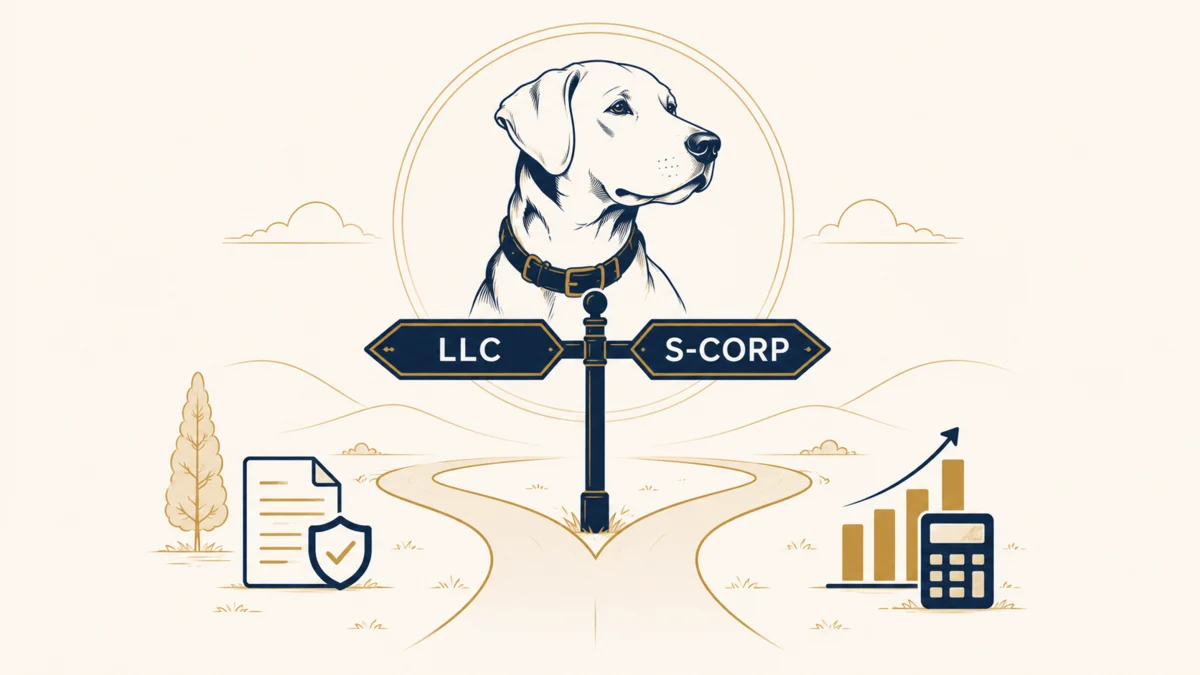
Choosing the Right Entity Matters
If you're starting or growing a business, you've probably wondered: Should I be an LLC or an S-corporation?
Our answer is often: Probably both.
That's because an LLC and an S-corp aren't really two competing choices. They do two different jobs.
The easiest way to think about it is like a cupcake:
LLC vs. S-Corp: What's the Difference?
The LLC is your legal structure
An LLC — short for limited liability company — is a legal business structure. When properly formed and maintained, it can help create separation between your business and your personal assets.
But forming an LLC doesn't, by itself, determine how your business will be taxed. If you don't choose a different tax treatment, the IRS applies a default classification. A single-owner LLC is generally taxed like a sole proprietorship, while a multi-owner LLC is generally taxed as a partnership. Both can potentially expose business income to self-employment taxes.
That's where the S-corp comes in.
The S-corp is your tax status
An eligible LLC can elect to be taxed as an S-corporation while still remaining an LLC under state law. So you can have: LLC legal structure + S-corp tax treatment.
The LLC provides the legal foundation. The S-corp election can potentially reduce the amount of your business income subject to employment taxes and create meaningful tax savings — but not every business needs the icing.
| LLC (Limited Liability Company) | S-Corp (S-Corporation) | |
|---|---|---|
| Provides personal liability protection | Provides personal liability protection | |
| Flexible taxation (passes through to your personal return) | Passes through, but allows you to pay yourself a salary and take distributions | |
| Generally simpler and less expensive to maintain | More complex, but can offer tax savings when profits are higher | |
| No requirement for payroll | Requires reasonable payroll for owner-employees |
Key Factors to Consider
An S-corporation comes with additional costs and responsibilities. There's payroll to run, an additional tax return to file, and more accounting and administrative work to manage.
So the real question isn't: Can an S-corp save me taxes? It's: Will it save me enough in taxes to justify the additional cost and complexity?
At SmartHound Accounting, our experience has been that the S-corporation conversation usually starts becoming worthwhile when a business reaches around $30,000 or more in annual net income.
That's not an IRS rule or a magic number. It's a practical starting point based on our experience working with owner-operated businesses. Below $30,000, the potential tax savings may be too small to justify the added expense. Above $30,000, it's time to start running the numbers — and as your profits grow, the potential savings can become much more significant.
Real-World Example
Imagine two business owners who each have an LLC.
Business Owner A earns $15,000 in annual net income. An S-corp might create some tax savings, but after adding the cost of payroll, an additional business tax return, and other administrative expenses, there may be little or no real financial benefit. For this owner, keeping things simple may be the better choice.
Business Owner B earns $80,000 in annual net income. Now there's much more potential for meaningful tax savings. Depending on the owner's individual circumstances, an S-corporation election could save thousands of dollars each year — even after accounting for the additional costs.
Same LLC. Different profit levels. Different answer.
What Most Business Owners Do
So, do you need an LLC and an S-corp? For many owner-operated businesses, the answer is:
If your business is generating less than $30,000 in annual net income, an S-corp may not yet provide enough savings to justify the additional cost and complexity.
If your business is generating more than $30,000 in annual net income — or you expect it to soon — it's probably time to have the conversation.
Final Thoughts
The decision isn't really LLC or S-corp? For many profitable business owners, it's LLC and S-corp.
And making that decision at the right time can quietly save you thousands of dollars in taxes year after year.
Next Steps
Think an S-corp might make sense for your business? If your business is earning more than $30,000 a year and you're still being taxed as a sole proprietor or partnership, it may be time to take a closer look.
At SmartHound Accounting, we help owner-operated businesses determine whether an S-corp makes sense, set up the right structure, and handle the bookkeeping, payroll, and tax work that comes with it.
Schedule a free 30-minute consultation, and we'll help you understand what makes sense for your business.
This guide is for general educational purposes and is not intended as legal or individualized tax advice. LLC liability protection varies by state and individual circumstances, and tax treatment depends on your specific situation.